Web3 creator publishing platform
Hifrenq
A web3 social publishing product that hides wallet, IPFS, signing, metadata, encryption, and on-chain reference complexity behind familiar creator workflows.
Hifrenq
Web3 publishing
Familiar surface
Normal app. Spicy pipes.
A creator platform where the user writes, publishes and manages content while the web3 work happens behind the curtain.

Hidden complexity
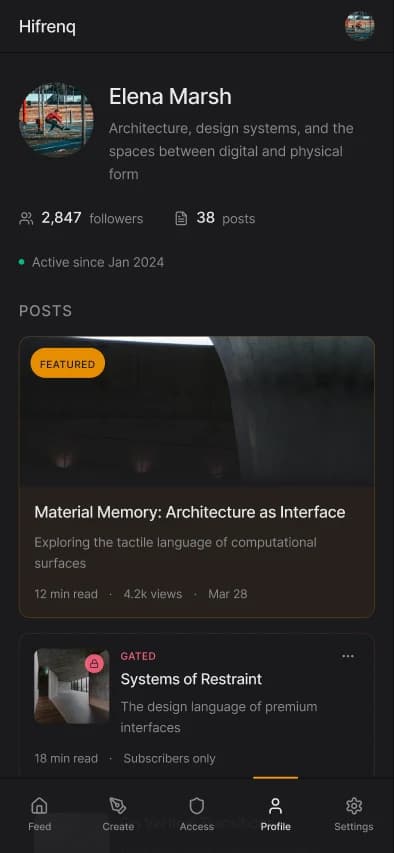
Web3 social apps usually start with a hazing ritual.
Connect wallet. Switch network. Sign this message. Approve that transaction. Wait, wrong chain. Where is your seed phrase? Please store these 24 words somewhere safe, but not too safe, because if you lose them you are spiritually and financially cooked.
Lovely stuff. No wonder normal people run away.
Hifrenq started from the opposite idea. What if decentralized publishing could feel like using an actual product?
Product surface
Write. Publish. Manage. Move on.

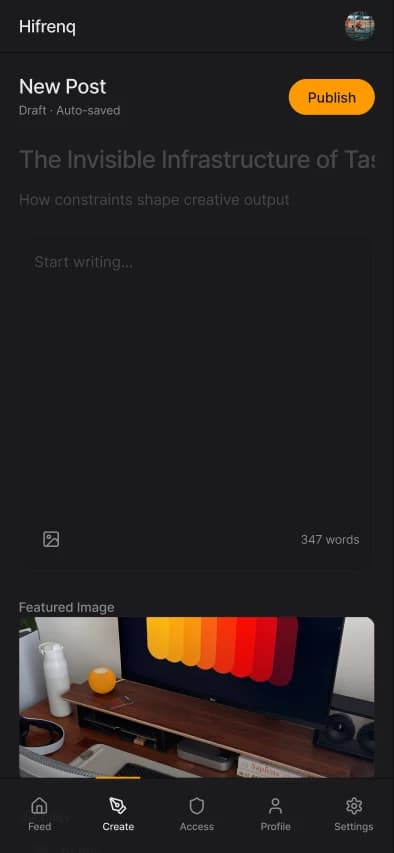
Make a profile. Write a post. Upload media. Manage your stuff.
Normal app behaviour, basically. Meanwhile, the platform deals with the spicy bits in the background: wallets, IPFS, signing, metadata, encryption, on-chain references and all the web3 poespas nobody should have to understand before they have even written their first post.
Not look mom, a dApp. More like: can we take the useful parts of decentralized publishing and hide enough of the pain so people do not feel like they accidentally joined a Discord server full of men explaining liquidity?
Access
Not just public or private.
The content model already pointed toward selective access, subscribers, token-gated communities and creator-controlled visibility.

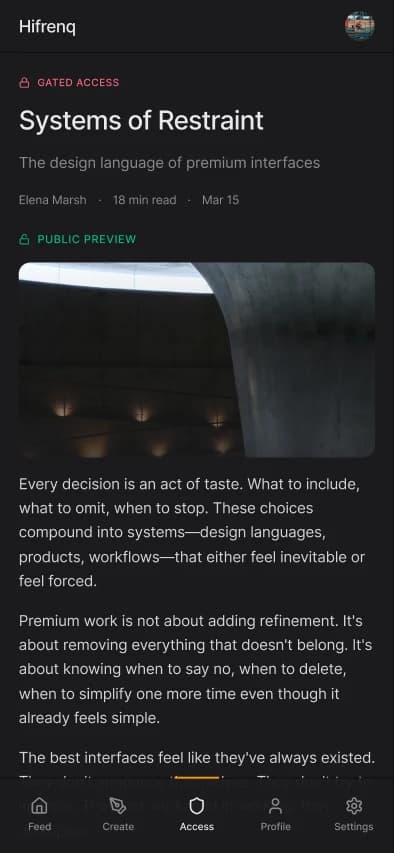
Not everything belongs on-chain just because you can put it there.
Firebase handled familiar onboarding. Wallets could be provisioned behind the scenes. Posts were packaged into structured metadata. Media was uploaded and pinned to IPFS. Optional fields could be encrypted or gated. The final content reference could then be committed on-chain through the platform's transaction flow.
Putting full content on-chain is often expensive, awkward, and mostly done to impress other people who already agree with you. Hifrenq took the saner path: store the rich content off-chain, make it durable through IPFS, and use the chain for ownership, references and state.

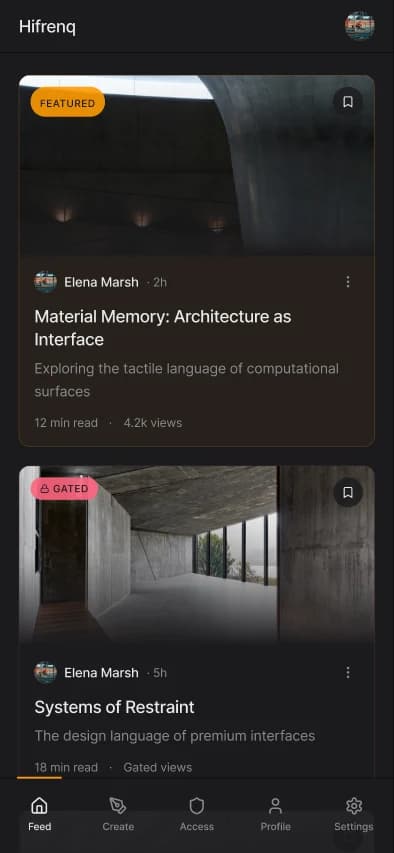
Feed
Product first. Chain second.
Public profiles, creator dashboards, rich post creation, media uploads, notifications and profile switching had to feel like normal app behaviour.
The creator model went deeper than a basic feed.
Profiles, posts, permissions, followers, media, creator identities, dashboard flows, post visibility and content access all had to work together. That makes it feel like a product instead of a wallet-connect demo with a timeline slapped on top.
One of the more interesting parts was the hybrid auth model. Users could start with something familiar, while still ending up with blockchain-backed ownership underneath. That is probably the right direction for most consumer web3 products.
Integrity
Storage, proof, wallet, done.
The backend did the real glue work: upload parsing, metadata, Firebase Admin, Pinata/IPFS, decryption endpoints, wallet creation, route versioning, Sentry and signing flows.

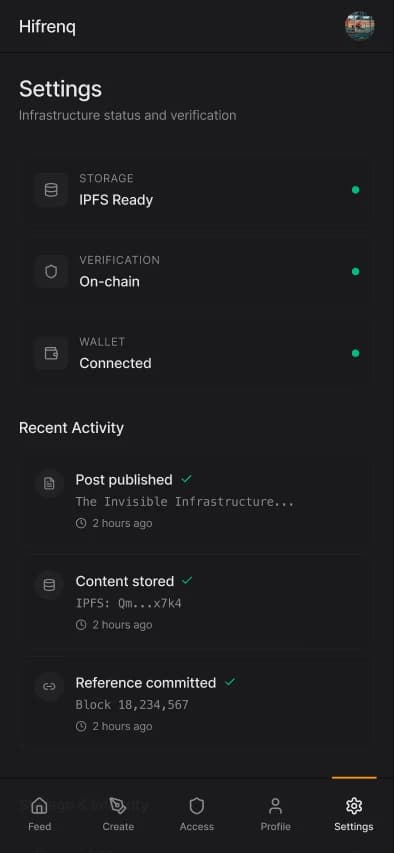
Web3 as infrastructure, not as personality.
The user wants to publish. The system can worry about markdown, media, metadata, IPFS, encrypted fields, content URIs and transactions. Software should carry the boring complexity, not hand it to the user like homework.
No casino vibes. No gm as product strategy. No making people suffer through raw blockchain complexity to prove they are early.
Just a creator platform that tries to make decentralized publishing feel closer to normal publishing. Which, honestly, is probably the only way any of this stuff becomes useful to people outside the bubble.
The useful parts of decentralized publishing are infrastructure. The product should still feel like a product.